Is Collagen Protein? Yes, Here's What That Means
Collagen is a protein, but not a complete one. What that means, how it compares with whey, and whether collagen counts towards your daily protein.
Written by Organic Gains. Published 6 November 2026.
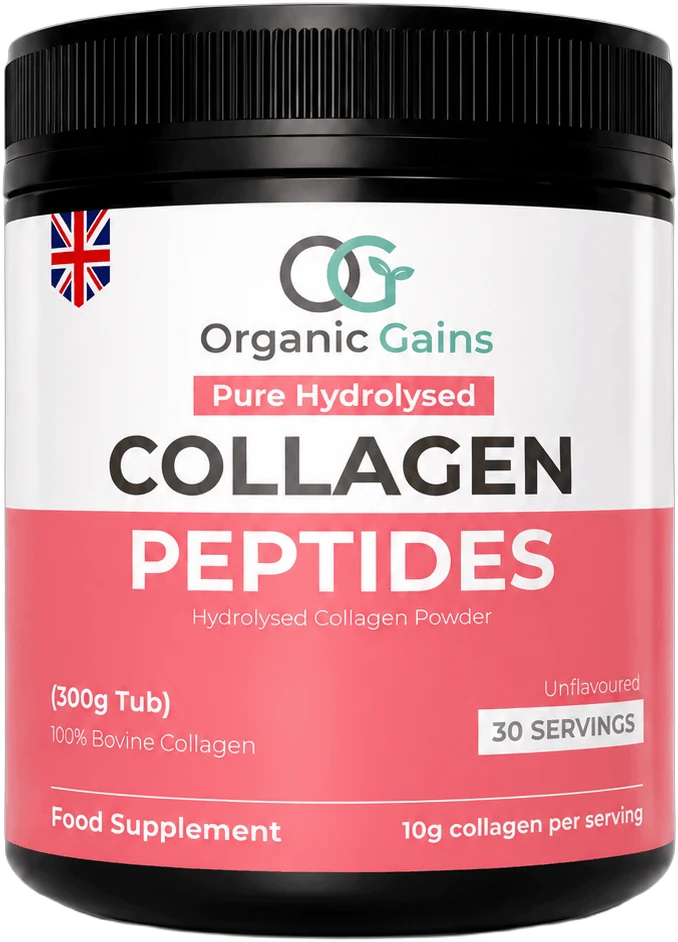
Yes, collagen is a protein, and a 10g serving of our collagen powder lists 9g of it on the label. It is also an unusual protein, missing one of the amino acids you have to get from food, so here is what that means for how you count it.
Is collagen protein?
Yes. Proteins are made up of chains of amino acids, which the British Nutrition Foundation calls the building blocks of protein. Collagen is built from three of those chains wound tightly together, and its mix is unusual: it is especially rich in three amino acids called glycine, proline and hydroxyproline, with glycine sitting at every third place along each chain.
It is also one of the body's main proteins. A chapter on collagen on the US National Library of Medicine's online bookshelf calls it the most abundant structural protein in the human body, found in skin, bone, cartilage, tendons and ligaments. A 2019 paper in the journal Nutrients put the body's collagens at 25 to 30% of all its protein.
Collagen powder is close to pure protein. Our Pure Hydrolysed Collagen Peptides list 9g of protein in every 10g serving, which is 90g of protein per 100g of powder. "Hydrolysed" means the collagen has been broken down into shorter chains of amino acids, called peptides, and they still count as protein on the label.
Is collagen a complete protein?
No, and this is the one thing worth knowing before you count it. Of the 20 amino acids commonly found in food proteins, nine have to come from an adult's diet, because the body cannot make them. The British Nutrition Foundation lists them: isoleucine, leucine, lysine, methionine, phenylalanine, threonine, tryptophan, valine and histidine. A protein that carries all nine is sometimes called a complete protein.
Here is the surprise. The British Nutrition Foundation explains that protein from animal sources carries the full range of essential amino acids. Collagen comes from animals too, yet it is the exception. Collagen lacks tryptophan, and the 2019 Nutrients paper noted that this is why it is classed as an incomplete protein.
Does that matter? Much less than it sounds. As the 2019 paper put it, collagen is never eaten as the only or main source of protein. The paper modelled a typical American diet and found that collagen peptides could make up as much as 36% of the day's protein while the diet still met its essential amino acid needs. The rest of what you eat fills the tryptophan gap.
Does collagen count towards your daily protein?
Yes. It is protein, and the label counts it as protein: 9g in every 10g serving.
The numbers on the label show it too. Protein gives 4kcal per gram, according to the British Nutrition Foundation, so 9g of protein is 36kcal, and 36kcal is the whole energy figure for a 10g serving. Under UK law, a food can be called a source of protein when at least 12% of its energy comes from protein, as the Annex to Regulation 1924/2006 sets out. In our powder, protein supplies all of it.
To put 9g in context, the British Nutrition Foundation gives the UK's Reference Nutrient Intake for protein as 0.75g per kilogram of body weight a day for adults, which works out at 45g a day for women and 56g for men, based on body weights of 60kg and 75kg. So one serving gives a woman of 60kg a fifth of that figure.
Count it as protein, then, and keep eating your usual mix of protein foods alongside it, since that mix is where your tryptophan comes from.
Collagen vs whey protein
Put whey and collagen side by side and their amino acids could hardly be more different. A 2020 trial in the American Journal of Clinical Nutrition published what was in each 30g serving of the whey and collagen supplements it used:
| In each 30g serving | Whey | Collagen |
|---|---|---|
| All essential amino acids | 15.4g | 5.6g |
| Leucine | 4.3g | 0.9g |
| Tryptophan | 0.7g | 0g |
| Glycine | 0.5g | 8.0g |
| Proline | 1.4g | 4.5g |
So whey carried nearly three times the essential amino acids, while collagen carried far more glycine and proline.
In the trial itself, 22 women with an average age of 69 took 30g of whey or 30g of collagen twice a day for six days, and the researchers measured muscle protein synthesis, the rate at which the muscles made new protein. Each woman exercised one leg and rested the other, and muscle protein synthesis was greater with whey than with collagen in both legs. Over the six days, it rose with whey, and with collagen it did not rise significantly above where it started. The researchers concluded that this suggested whey was the more effective supplement for supporting muscle retention in older women.
Do collagen gummies have protein?
Collagen is a protein, so a collagen gummy carries some. Our Marine Collagen Gummies carry 1,000mg of hydrolysed marine collagen in two gummies, and their label gives no protein figure, so we do not give one either. If protein is the number you are counting, the powder is the one that lists it: 9g in a 10g serving. Our guide to whether collagen gummies work covers the gummies themselves.
What protein does, and what is in our powder
Because our collagen powder counts as a source of protein, UK law lets us tell you what protein does, in these words:
- Protein contributes to a growth in muscle mass.
- Protein contributes to the maintenance of muscle mass.
- Protein contributes to the maintenance of normal bones.
These are claims about protein. No health claim is authorised for collagen itself, so we make none.
Our Pure Hydrolysed Collagen Peptides have one ingredient: 100% hydrolysed bovine collagen peptides. A serving is 10g, two heaped scoops, once a day, and each serving lists 9g of protein, 36kcal, no fat, no carbohydrate and 0.04g of salt, with 2,210mg of glycine, 1,330mg of proline and 1,100mg of hydroxyproline. A 300g tub holds 30 servings. The label marks it gluten free with no added sugar, and it is not suitable for vegetarians or vegans. It has no taste, so it goes into coffee, tea, juice, porridge or a smoothie, and our guide to how to take collagen powder has the details.
Adding collagen protein to your day
If you want 9g of protein a day with no flavour to get past, a serving of our collagen peptides powder stirred into your morning coffee or porridge does it. Count it as protein, and keep your other protein foods in the mix for the tryptophan.