Marine Collagen vs Bovine Collagen: What's the Difference?
Marine collagen comes from fish and bovine collagen from cattle. How they compare on collagen type, amino acids, absorption research, diet and allergies.
Written by Organic Gains. Published 30 October 2026.
Marine collagen comes from fish, bovine collagen comes from cattle, and both are sold as hydrolysed collagen, which is collagen cut into small pieces. The differences that matter when you choose are your diet, allergies, how much collagen you get in a serving and the form you take it in, so this guide takes them one at a time.
What is the difference between marine and bovine collagen?
The main difference is the animal. Marine collagen is made from fish, and bovine collagen is made from cattle. Here is how they compare side by side.
| Marine collagen | Bovine collagen | |
|---|---|---|
| Made from | Fish, such as skin, scales and bones | Cattle by-products, such as hides and bones |
| Collagen type | Type I, from fish skin, scales and bones | Type I, and cattle are its main source |
| Suits vegetarians or vegans | No | No |
| One of the 14 allergens food law requires businesses to declare | Yes, fish | No |
Collagen is the same kind of thing in both: a structural protein. A 2020 review of marine collagen describes it as the main structural part of the connective tissues, such as skin, bones, ligaments, tendons and cartilage.
Where marine and bovine collagen come from
Marine collagen can be made from the parts of a fish left over when it is prepared for food. A 2020 review of fish collagen lists fish bones, scales and skin as sources, and the 2020 review of marine collagen notes that the skin, bones and scales thrown away by fish processing are rich in collagen.
Bovine collagen comes from cattle. The marine collagen review notes that for many years, most collagen available was extracted from the leftovers of the cattle and pig processing industries. A 2019 review of hydrolysed collagen adds that cattle are the main source of type I collagen because of their availability.
Are marine and bovine collagen different types?
Usually not. The 2020 fish collagen review describes collagen from fish skin, scales and bones as type I, and collagen from fish cartilage as mostly type II. The 2019 review names cattle as the main source of type I collagen.
There are nearly 28 known types of collagen, according to the 2019 review. Type I is the most common, found in skin, bone, teeth, tendons and ligaments. Type II is found in cartilage, and type III in skin, muscle and blood vessels.
What hydrolysed collagen means
Collagen in the body is a long, tightly wound molecule: three chains of amino acids, each around 1,014 amino acids long, twisted together, according to the 2019 review. To make hydrolysed collagen, the chains are separated and then cut up by enzymes, and the result is a mix of small pieces called peptides. Think of it as chopping a long rope into short lengths of string.
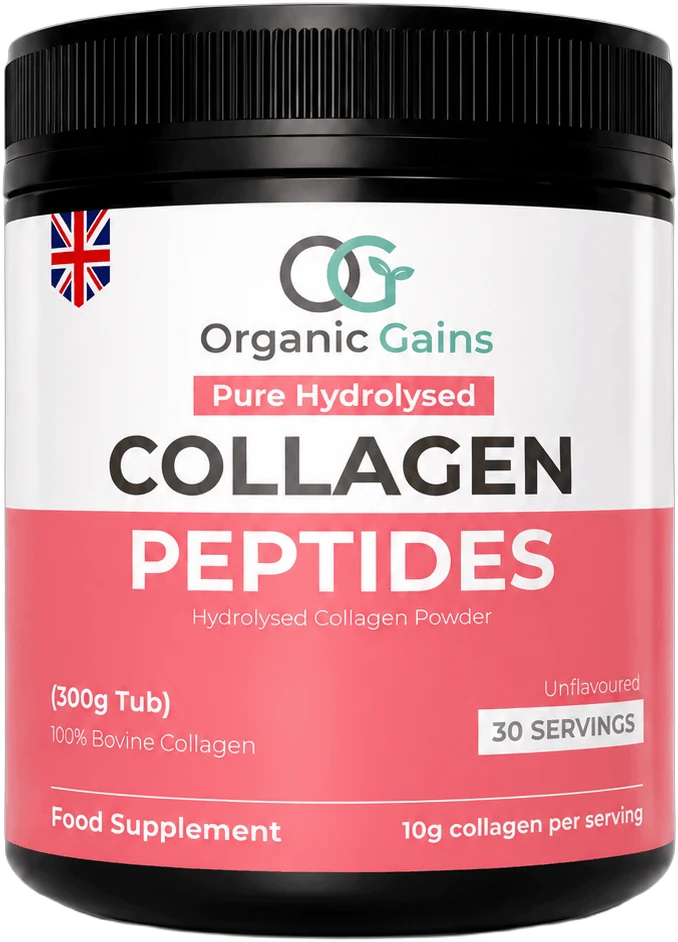
Both of ours are hydrolysed. The gummies carry hydrolysed marine collagen, and the powder is 100% hydrolysed bovine collagen peptides.
Do marine and bovine collagen have different amino acids?
They share the same pattern, with some differences in the amounts. In collagen, glycine sits at every third position along the chain, and the position just before each glycine is often taken by proline or hydroxyproline, according to the 2020 marine collagen review. The 2019 review puts glycine at about 33% of collagen, and proline and hydroxyproline together at about 22%.
You can see that pattern on the label of our powder. Every 10g serving lists 2,210mg of glycine, 1,330mg of proline and 1,100mg of hydroxyproline.
Marine collagen tends to carry less hydroxyproline. The 2020 marine collagen review noted that the amount varies with the fish species and the temperature of the water it lived in, and is lower than in the collagen of other vertebrates.
Is marine collagen better absorbed than bovine?
You will often read that it is. Here is what two human studies measured.
A 2007 study by Ohara and colleagues gave five healthy men hydrolysed gelatin, which is made from collagen, from fish scales, fish skin and pig skin on separate occasions. It measured hydroxyproline, one of collagen's amino acids, in their blood over 24 hours, both free and in small fragments. The total from fish scales was significantly higher than from pig skin, and the kinds of fragments differed between sources. It did not test bovine collagen.
A 2024 study by Virgilio and colleagues did. Six healthy volunteers, three women and three men, took a single 10g dose of hydrolysed collagen from fish skin, pig skin and cattle hide on separate days. The uptake of free hydroxyproline was comparable across all of them, with no significant differences. The study was funded by the company that supplied the collagen it tested, and five of its nine authors worked for that company.
Both studies were small, and both measured what reached the blood, not any effect on the body. UK law authorises no health claim for collagen from either source. If your question is whether collagen gummies do anything, our guide to whether collagen gummies work goes through it.
Marine vs bovine collagen for your diet and allergies
This is where the choice is clearest.
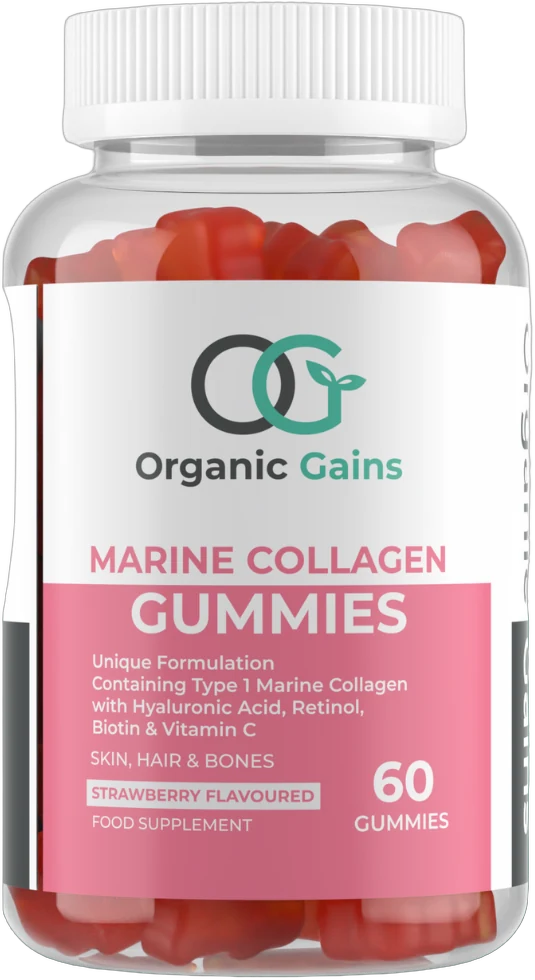
If you are allergic to fish, marine collagen is made from fish. Fish is one of the 14 allergens that food law requires businesses to declare, according to the Food Standards Agency, and our Marine Collagen Gummies are labelled "contains fish".
If you avoid beef, bovine collagen is made from cattle. Our collagen powder is labelled not suitable for vegetarians or vegans.
If you eat fish but not meat, marine collagen fits your diet and bovine collagen doesn't.
If you are vegan or vegetarian, neither fits, because both are made from animals.
Both of ours are marked gluten free.
Our marine and bovine collagen, compared
Our two collagens are different products as well as different animals, so the choice often comes down to how you want to take it and how much you want.
Marine Collagen Gummies give you 1,000mg of hydrolysed marine collagen in two strawberry gummies a day, with 80mg of vitamin C, 3,000µg of biotin, 14mg of vitamin E and 50mg of hyaluronic acid. Vitamin C contributes to normal collagen formation for the normal function of skin. Biotin contributes to the maintenance of normal hair and normal skin, and vitamin E contributes to the protection of cells from oxidative stress. A jar of 60 is a month's supply, with nothing to mix.
Pure Hydrolysed Collagen Peptides give you 10g of hydrolysed bovine collagen in two heaped scoops, ten times the collagen in a serving of the gummies, with 9g of protein. Protein contributes to the maintenance of muscle mass and to the maintenance of normal bones. The powder has no taste, so it goes into coffee, tea, juice, porridge or a smoothie, and a 300g tub holds 30 servings. Our guides to whether collagen is protein and how to take collagen powder cover the powder in more detail.
If you'd like a strawberry gummy with vitamin C and biotin in the same serving, start with the Marine Collagen Gummies. If you want the larger daily amount and are happy to stir it into a drink or your porridge, the collagen peptides powder is the one. Both ship free in the UK on orders of £50 and over.