Vitamin D3 and K2: Why Take Them Together?
Why vitamin D3 and K2 come together: what each one is, the claims the law allows, UK winter vitamin D advice, safe amounts, and warfarin.
Written by Organic Gains. Published 10 March 2026. Updated 6 November 2026.
Vitamin D3 and vitamin K2 turn up together because both carry authorised claims for your bones in Great Britain, and vitamin D's claims cover calcium as well. Here is what each one is, what those claims say word for word, what the UK advises on vitamin D, how much is safe, and who should check with a doctor first.
What are vitamin D3 and K2?
Vitamin D3 is cholecalciferol. The European Food Safety Authority (EFSA) named it in its 2023 opinion on vitamin D as one of the forms of vitamin D, alongside vitamin D2, ergocalciferol. Your body makes vitamin D from sunlight on your skin, and a small number of foods carry it, such as oily fish, red meat and egg yolks, according to the NHS.
Vitamin K2 is one of the two natural forms of vitamin K. EFSA's 2017 opinion on vitamin K explained that vitamin K comes in food as phylloquinone (vitamin K1), found mainly in dark green leafy vegetables, and menaquinones (vitamin K2), found mainly in animal products such as meat, cheese and eggs. Most menaquinones are made by bacteria, both the ones used to ferment food and some that live in your gut.
Why take vitamin D3 and K2 together?
Each one carries authorised claims for your bones, and two of vitamin D's are about calcium. Here they are, in the words the law allows:
- Vitamin D contributes to normal absorption/utilisation of calcium and phosphorus.
- Vitamin D contributes to normal blood calcium levels.
- Vitamin D contributes to the maintenance of normal bones.
- Vitamin K contributes to the maintenance of normal bones.
- Vitamin K contributes to normal blood clotting.
Vitamin D has more: it contributes to the maintenance of normal muscle function and normal teeth, and to the normal function of the immune system.
You may also read claims about vitamin K2 and your heart or blood vessels. None is authorised: Great Britain's register lists the claim that vitamin K2 contributes to vascular health as not authorised, so we don't make it.
What the UK advises on vitamin D
The NHS says that from about late March or early April to the end of September, most people should be able to make all the vitamin D they need from sunlight on their skin, but that between October and early March the sun isn't strong enough in the UK. So government advice is that everyone should consider taking a daily supplement containing 10 micrograms (µg) of vitamin D during autumn and winter.
The NHS goes further for some people. It says the Department of Health and Social Care recommends that adults take a daily 10µg supplement all year if they are not often outdoors, live in a care home or usually cover most of their skin outdoors, and that people with dark skin, for example from an African, African-Caribbean or south Asian background, should consider a daily 10µg supplement all year too.
Vitamin D labels often give the amount in international units (IU). The NHS explains that 1µg of vitamin D is 40 IU, so 10µg is 400 IU and 2,000 IU is 50µg.
How much vitamin D3 and K2 is safe?
Vitamin D. The NHS says 10µg a day will be enough for most people, and not to take more than 100µg (4,000 IU) a day, because too much over a long time can cause too much calcium to build up in the body. EFSA's limit of 100µg a day counts vitamin D from all sources, supplements included, so add up every supplement you take that has it. Some people have medical conditions that mean they may not be able to take as much safely, and the NHS says to ask your doctor if you are in doubt. Our guide to whether 2,000 IU of vitamin D is too much goes through the numbers in full.
Vitamin K. The NHS says you should be able to get all the vitamin K you need from a varied and balanced diet, and that taking 1mg (1,000µg) or less of vitamin K supplements a day is unlikely to cause any harm.
Vitamin K2 and warfarin
If you take warfarin, the NHS is clear: do not take vitamin K supplements, because vitamin K can affect how warfarin works. That includes vitamin K2, so our gummies are not for you. If you take any other medicine that thins your blood, or any medicine at all, ask your GP or pharmacist before you start a vitamin K supplement.
Where magnesium fits
Magnesium comes in our gummies as magnesium glycinate, 200mg in each gummy. Magnesium has authorised claims of its own, but a food may carry them only when it gives you enough magnesium itself, and the label does not say how much of the 200mg of magnesium glycinate that is, so no claim is made for the magnesium in our gummies.
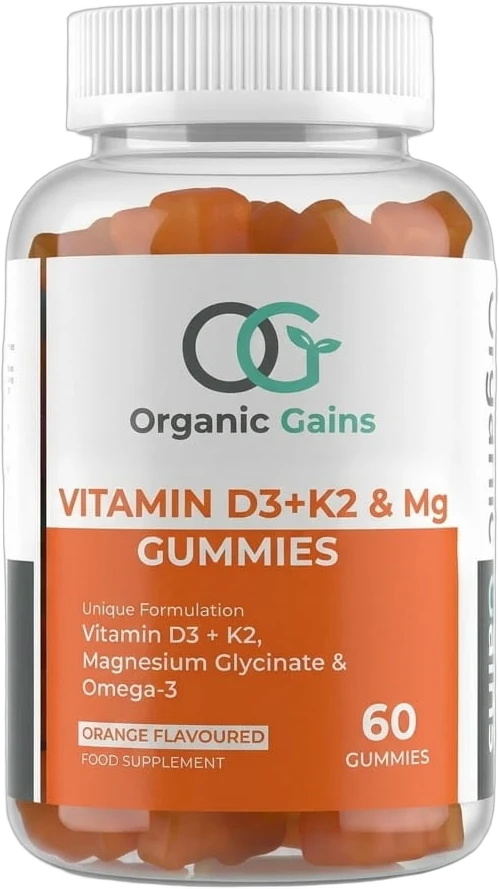
Our Vitamin D3, K2 & Magnesium Gummies
Our Vitamin D3, K2 & Magnesium Gummies put all three into one orange gummy. The label allows one or two a day:
| 1 gummy | 2 gummies | |
|---|---|---|
| Vitamin D3 (as cholecalciferol) | 2,000 IU (50µg) | 4,000 IU (100µg) |
| Vitamin K2 | 150µg | 300µg |
| Magnesium glycinate | 200mg | 400mg |
| Omega-3 (from chia seed) | 100mg | 200mg |
One gummy gives you five times the NHS's 10µg of vitamin D. Two gummies give you 100µg, the most the NHS says adults should take in a day, so if you get vitamin D from any other supplement, one gummy a day is the serving for you. Either serving keeps vitamin K well under the NHS's 1mg.
Vitamin D contributes to the normal function of the immune system and to the maintenance of normal bones and normal muscle function, and vitamin K contributes to the maintenance of normal bones. The omega-3 comes from chia seed, and no claim is made for it here.
There are 60 gummies in a jar, which lasts two months at one a day. The label marks them gluten free and no added sugar. A gummy is chewed, so there is no tablet to swallow, and the label carries this warning: if you are pregnant, breastfeeding, taking medication or under medical supervision, ask your doctor before use, and keep the jar out of reach of young children.
Taking vitamin D3 and K2
If you want vitamin D through the autumn and winter with K2 and magnesium in the same chew, one orange gummy a day does it. Vitamin D3, K2 & Magnesium Gummies give you 2,000 IU of vitamin D3 and 150µg of vitamin K2 in each gummy, with free UK delivery on orders of £50 and over.