Creatine for Older Adults: Strength Training Over 55
The UK's creatine claim for adults over 55, word for word, and what it asks of you: 3g a day, training three times a week, and 65 to 75% of your max.
Written by Organic Gains. Published 9 November 2025.

The UK has a health claim for creatine written for adults over 55, and it comes with a training plan attached. Here is the claim word for word, what each of its conditions means in plain English, and what a week of that training can look like.
The creatine claim for adults over 55
Great Britain's register of authorised nutrition and health claims holds one creatine claim written for this age group. These are its exact words:
Daily creatine consumption can enhance the effect of resistance training on muscle strength in adults over the age of 55.
The claim comes with conditions you have to be told, and here they are: the claim is for adults over the age of 55 who are engaged in regular resistance training, and the beneficial effect is obtained with a daily intake of 3g of creatine in conjunction with resistance training, which allows an increase in the workload over time and which should be performed at least three times a week for several weeks, at an intensity of at least 65% to 75% of one repetition maximum (the most weight you can lift once).
That is a lot packed into one sentence, so the rest of this guide takes it one piece at a time.
Who the claim is for
Adults over the age of 55 who do regular resistance training, women and men alike. Both parts matter. If you are over 55 and do not do resistance training, the claim does not describe you, because it is about creatine in combination with resistance training. If you are 55 or under, there is a different creatine claim for adults who do high intensity exercise, which we come to further down.
What counts as resistance training?
Resistance training means making your muscles work against a weight or a force. The NHS lists lifting weights, working with resistance bands, and exercises that use your own body weight, such as push-ups and sit-ups, among its muscle-strengthening activities. For this claim, though, the training also has to be hard enough, and that is the next condition.
What does 65 to 75% of your one repetition maximum mean?
Your one repetition maximum, often written 1RM, is the most weight you can lift once in a given exercise. The register defines it as "the maximum weight or force an individual can exert in a single lift". Training at 65 to 75% of it means lifting a set share of that number.
Here is how the sums work. If the most you can push once on a leg press is 60kg, then 65 to 75% of it is 39 to 45kg. If the most you can curl once with a dumbbell is 10kg, your working weight is 6.5 to 7.5kg. Every exercise has its own one repetition maximum, so every exercise has its own working weight. If you have never measured yours, a qualified gym instructor can help you work it out.
Why the weights have to go up over time
The claim asks for resistance training "which allows an increase in the workload over time". In plain words, the programme has to have room to get heavier as the weeks go by. If your one repetition maximum goes up, the weight that was 70% of it becomes a smaller share, so staying at 65 to 75% means adding weight.
The American College of Sports Medicine's 2009 position stand on resistance training gave a simple rule for this: once you can do one or two more repetitions than you are aiming for, add 2 to 10% to the weight. On a 40kg lift, that is an extra 0.8 to 4kg.
Why creatine every day, and why 3g?
The word "daily" is in the claim for a reason. When the European Food Safety Authority (EFSA) weighed the evidence in its 2016 opinion, it found that the studies supported an effect on muscle strength in adults over 55 from creatine taken at 3g a day or more alongside regular resistance training, three times a week for several weeks. It also noted that no such effect was seen when a similar weekly amount of creatine was taken on training days only.
So the 3g goes in every day, on rest days as well as training days.
What EFSA looked at
The claim began as an application to EFSA, the body that assessed health claims for the European Union, and its panel published its opinion on 23 February 2016. The panel was given 21 human intervention studies, meaning trials where people actually took creatine, and two meta-analyses, which combine the results of several studies. It decided that no conclusions could be drawn from 11 of the studies, and that the two meta-analyses could not be used to back the claim.
Weighing what was left, the panel concluded that "a cause and effect relationship has been established between the consumption of creatine in combination with resistance training and improvement in muscle strength in adults over the age of 55." The claim was authorised by Regulation (EU) 2017/672 of 7 April 2017, and Great Britain's register lists it as authorised for use in Great Britain.
What a week of training can look like
Here is one way to fit the conditions into a week, as an outline you can take to a gym instructor rather than a full programme.
Train on three days with a rest day between them, such as Monday, Wednesday and Friday. That is one more strength day than the NHS minimum of two a week. In each session, work the major muscle groups the NHS lists: legs, hips, back, abdomen, chest, shoulders and arms. Choose a handful of exercises that cover them, on weights, machines or bands you can set at 65 to 75% of your one repetition maximum. The NHS's own test for strength work is to do it to the point where you need a short rest before repeating the activity.
Write down your weights each session. When a set gets easy, add a little weight, by the 2 to 10% rule above. Take your creatine every day, training days and rest days alike, and keep the routine going week after week, because the claim's conditions talk of several weeks.
If you have not exercised for some time, or you have a health condition or concerns, the NHS advises speaking to a GP before you start.
Creatine for women over 50
The over-55 claim covers women and men alike, so once you are over 55 it is yours, with the same conditions. If you are in your early fifties, the over-55 claim does not apply to you yet, but the general creatine claim does if you do high intensity exercise: creatine increases physical performance in successive bursts of short-term, high intensity exercise, and the beneficial effect is obtained with a daily intake of 3g of creatine. Our guide to creatine for women goes further.
Is creatine safe over 55?
A 2025 analysis of 685 clinical trials found side effects were reported by 4.60% of the people taking creatine and 4.21% of the people taking a placebo, a look-alike with no creatine in it. When the researchers split the results by age, they noted some significant differences between the age groups, but the gaps between creatine and placebo were in most cases under half a percentage point, and in some cases side effects were more common on the placebo. Our guide to creatine side effects covers water weight, stomach upset, kidneys and the rest.
If you have a health condition or take any medicine, ask your GP or pharmacist before you start creatine. The label says the same: if you are pregnant, breastfeeding, taking medication or under medical supervision, ask your doctor before use.
Getting 3g a day from Creatine Ultra+ Gummies
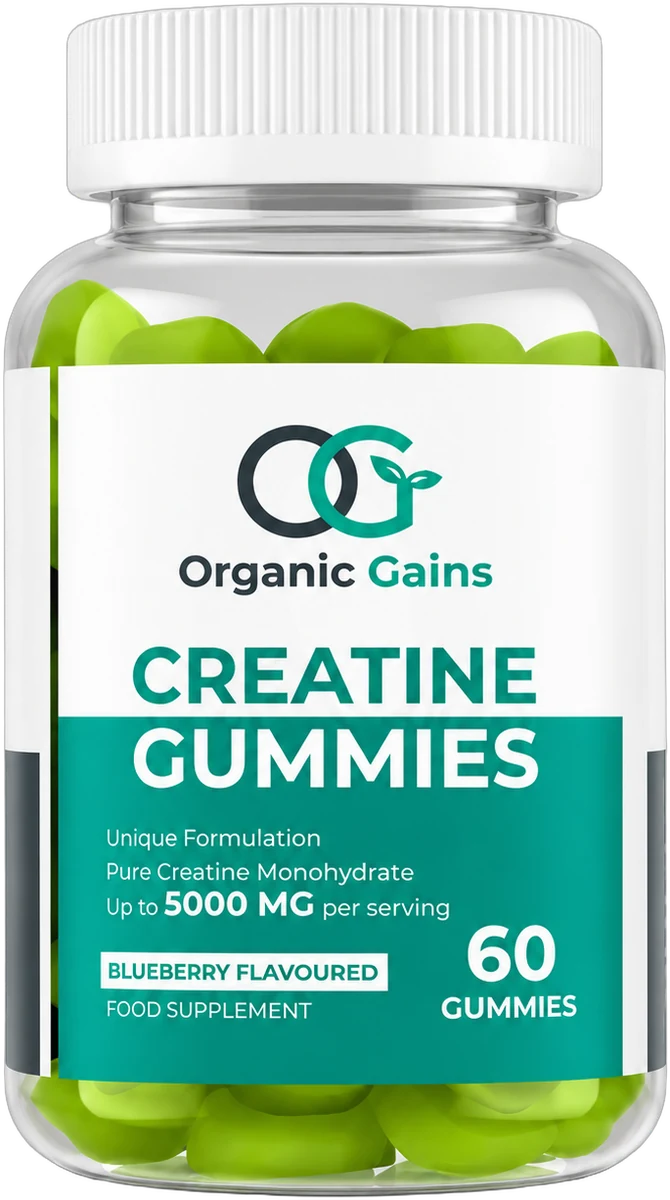
The 3g in the claim counts creatine itself, and our label prints creatine monohydrate, which is 87.9% creatine by weight, according to a 2011 review of the forms of creatine. Three of our Creatine Ultra+ Gummies carry 5,000mg of creatine monohydrate, which is about 4,395mg of creatine, so the three-gummy serving covers the 3g a day the claim is based on. Two gummies carry 3,333mg of creatine monohydrate, which is about 2,930mg of creatine, just under 3g, so for this claim, take three. A jar of 90 blueberry gummies lasts 30 days at three a day. Three gummies also carry 1,500mg of GAA (guanidinoacetic acid), 30kcal and 3g of sugars. No health claim is authorised for GAA. The label marks the gummies gluten free, vegan and with no added sugar.
Starting creatine over 55
If you are over 55 and training with weights three times a week, the plan is simple: keep the weights at 65 to 75% of your one repetition maximum, add a little weight when the sets get easy, and take 3g of creatine every day. Three Creatine Ultra+ Gummies a day give you that with nothing to measure or mix, and if you have a health condition or take any medicine, check with your GP or pharmacist first.