Do Creatine Gummies Work? What the Study and Lab Tests Found
What the first trial of creatine gummies in athletes and the 2024 and 2025 lab tests found, and how to check a gummy label for 3g of creatine a day.
Written by Organic Gains. Published 9 April 2026.
A creatine gummy carries the same creatine monohydrate as a scoop of powder, so the real question is whether the creatine on the label is actually inside it, and whether there is enough of it. Lab tests in 2024 and 2025 found some gummies on sale with little or none, so here is what the tests and the first trial of creatine gummies in athletes found, and how to read a label before you buy.
Do creatine gummies work?
They do when two things are true: the creatine on the label is in the gummy, and the gummies you take each day add up to at least 3g of creatine. Here is why 3g is the number. Creatine increases physical performance in successive bursts of short-term, high intensity exercise, and the beneficial effect is obtained with a daily intake of 3g of creatine. That is the health claim authorised for creatine in Great Britain, and it is meant for adults who do high intensity exercise: short, hard efforts with rests between them, like the sprints in a football match, sets in the gym or rounds in a circuit class.
The claim is about creatine, whatever form it comes in, so it applies to a gummy that gives you 3g a day just as it does to a powder.
Creatine itself is a natural compound, and your body keeps about 95% of it in your muscles, according to the International Society of Sports Nutrition's 2017 position stand. About half of what your body uses each day comes from food, mainly red meat and seafood, and your body makes the rest, mostly in the liver and kidneys.
The form to look for is creatine monohydrate. It has been the most studied form of creatine since the early 1990s, and a 2021 review in the society's journal concluded that other forms of creatine are not superior to it.
What the first trial of creatine gummies in athletes found
Most creatine research has used powder. By its authors' account, the first trial of creatine gummies in athletes was published in March 2026 in the Journal of Functional Morphology and Kinesiology. The researchers gave 17 female college and professional beach volleyball players 5g of creatine monohydrate a day, in gummies, for 10 weeks, and compared them with 15 players who took nothing.
After the 10 weeks, the creatine group's average jump height had gone up by 2.1cm, from 41.8cm to 43.9cm, and they were 0.34 seconds faster on a shuttle test of changing direction at speed. The other group's jump height fell by 1.7cm, and their shuttle time stayed about the same. The study found no significant difference between the groups in muscle mass or reaction time.
Two details help you read it fairly. The other group got no dummy gummy, so every player knew whether she was taking creatine. And the authors noted that the gummies they used had been independently checked to contain the creatine on their label. That matters, as the next section shows.
Do creatine gummies actually have creatine in them?
Not always, and two sets of lab tests have shown it.
In March 2024, a US supplement maker reported testing 12 brands of creatine gummies bought online. Seven met the amount on their labels. The other five contained little to no creatine. No outside lab checked these results, because the maker said none of the labs it normally used were able to test gummies.
In June 2025, a company that tracks supplements reported that it had bought six popular creatine gummies sold online and had an independent lab test them. Four failed. Two came back with no creatine at all. One, whose label said two gummies made a 5g serving, held 0.005g in two gummies: under 0.1 percent of what was listed. The same company had five creatine powders tested too, and all five contained around 5g of creatine per serving, in line with what they claimed.
In both tests, the failing gummies contained creatinine, the substance creatine turns into when it breaks down. That points to why a gummy is harder to get right than a powder. The 2021 review explained that creatine monohydrate powder stays stable for years, while creatine in a liquid turns into creatinine, especially when it is warm or acidic. Most ways of making gummies involve heat, so the creatine in a gummy has to come through being made, and then its time on the shelf.
A label can't prove what is inside a gummy. What it can show you is whether the dose is there on paper, and how clearly the maker has set it out.
How to read a creatine gummy label
The form of creatine. Look for creatine monohydrate by name, because it is the form the research has studied most.
The amount, and how many gummies it takes. Labels give the amount per serving, so check how many gummies make one serving and add up what you would take in a day. You want at least 3g of creatine a day, because that is the daily intake the authorised claim is based on. Creatine monohydrate is 87.9% creatine, according to the 2021 review, so 3g of creatine takes about 3.4g of creatine monohydrate.
How long a jar lasts. Divide the gummies in the jar by the number you take each day. The 3g is a daily intake, so it helps to know how many days a jar gives you.
The sugars. Check the sugars per serving, because they add up when you take two or three gummies every day.
Our Creatine Ultra+ label, read the same way
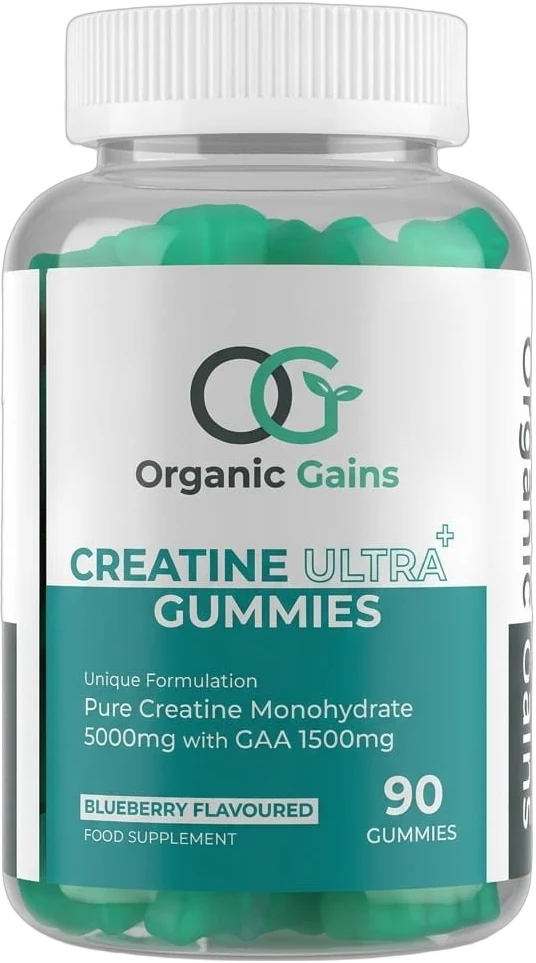
Creatine Ultra+ Gummies name creatine monohydrate on the label and print the amounts for both servings the label allows, two or three gummies a day:
| 2 gummies | 3 gummies | |
|---|---|---|
| Creatine monohydrate | 3,333mg | 5,000mg |
| GAA (guanidinoacetic acid) | 1,000mg | 1,500mg |
| Energy | 20kcal | 30kcal |
| Sugars | 2g | 3g |
| A jar of 90 lasts | 45 days | 30 days |
Three gummies give you 5,000mg of creatine monohydrate, which is about 4,395mg of creatine, more than 3g a day. For adults who do high intensity exercise, the three-gummy serving covers the daily intake the claim is based on: creatine increases physical performance in successive bursts of short-term, high intensity exercise, and the beneficial effect is obtained with a daily intake of 3g of creatine.
The GAA is what sets Creatine Ultra+ apart from our plain creatine gummies. No health claim is authorised for GAA in Great Britain, so here we tell you only how much there is. The other ingredients are water, pectin, sodium citrate, citric acid, stevia and vegetable oil (contains carnauba wax). The jar holds 90 blueberry gummies, and the label marks them gluten free, vegan and no added sugar.
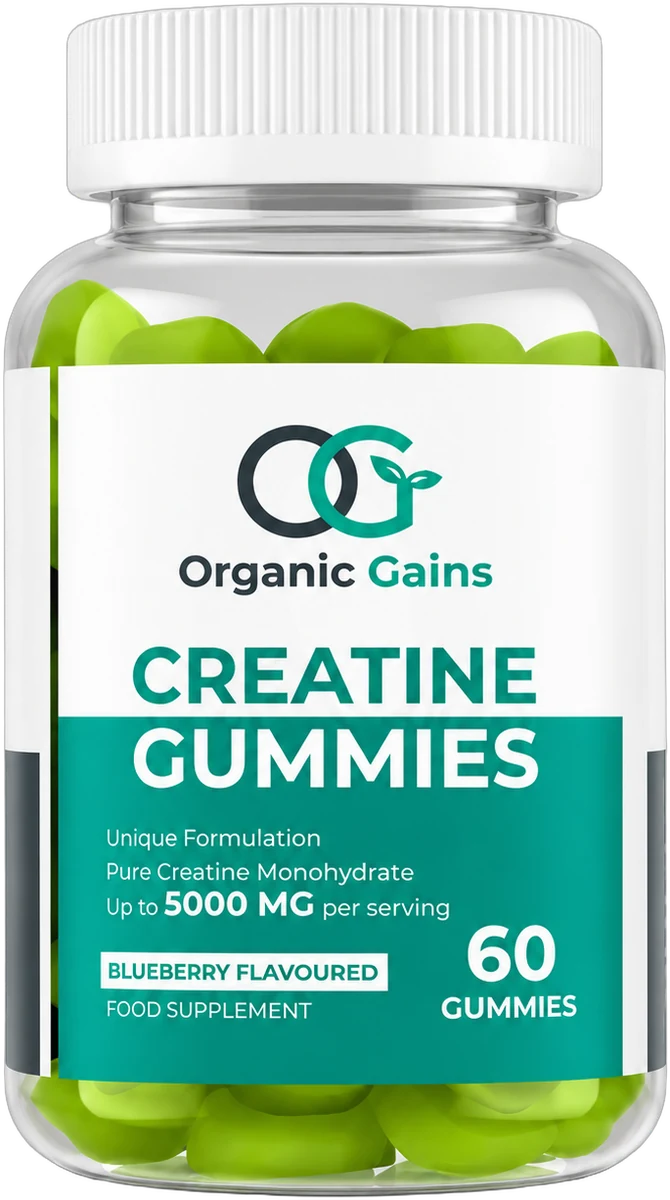
If you would rather have creatine monohydrate on its own, our Creatine Gummies carry no GAA: up to 5,000mg of creatine monohydrate in a serving of three blueberry gummies, 60 to a jar, which lasts 20 days at three a day.
Are creatine gummies as good as powder?
The creatine monohydrate is the same in both, so gummies that give you 3g or more of creatine a day, as their label says, give you the same creatine as a scoop. Powder has the much longer research record, and in the 2025 tests all five powders matched what they claimed while four of the six gummies failed. A gummy wins on the dose already measured out, the taste, and having nothing to mix or wash up. Our guide to creatine gummies vs powder goes through the differences one by one.
How long do creatine gummies take to work?
At 3 to 5g a day, the 2021 review pointed to about four weeks. It described a study in which people who took 3g a day for 28 days ended up with a similar rise in muscle creatine, about 20%, to people who took 20g a day for six days. It said that 3 to 5g a day for at least four weeks reached a similar level to a "loading" phase, which means 20 to 25g a day for five to seven days. Our guide to how long creatine takes to work covers loading and the timeline in full.
Is it safe to take creatine gummies every day?
The society's 2017 position stand said that taking creatine, short term and long term (up to 30g a day for five years), was safe and well tolerated in healthy people. The 2021 review concluded that creatine taken at recommended doses did not cause kidney damage in healthy people. If you have a health condition, take medication, or are pregnant or breastfeeding, ask your GP or pharmacist before you start. Our label says the same: if you are pregnant, breastfeeding, taking medication or under medical supervision, ask your doctor before use. Our guide to creatine gummies side effects covers the rest.
Choosing your creatine gummy
If you train hard in short bursts and want your creatine without a scoop, start with the label: creatine monohydrate by name, the amount per serving printed plainly, and enough to reach 3g of creatine a day. Creatine Ultra+ Gummies give you 5,000mg of creatine monohydrate in three blueberry gummies, with nothing to mix and free UK delivery on orders of £50 and over.