How Much Creatine Per Day? 3g, 5g, Loading and 10g
How much creatine to take a day: the 3g the UK claim rests on, the 3 to 5g research uses, loading, dosing by body weight, and whether 10g is too much.
Written by Organic Gains. Published 12 May 2025.
The usual answer is 3 to 5g of creatine a day, and each end of that range has a good reason behind it. Here is where the numbers come from, when people take more, and what each amount looks like in gummies.
How much creatine should you take per day?
For most adults who train, 3 to 5g of creatine a day.
The 3g comes from UK law: both of creatine's authorised claims are based on 3g a day. The first is for adults who do high intensity exercise: creatine increases physical performance in successive bursts of short-term, high intensity exercise, and the beneficial effect is obtained with a daily intake of 3g of creatine. High intensity here means going all out for a few seconds, resting briefly, and going again, like repeated sprints or jumps.
The 5g end comes from sports nutrition research. The International Society of Sports Nutrition (ISSN) wrote in its 2017 position stand on creatine that once muscle creatine stores were full, 3 to 5g a day could generally keep them there.
Why 3g a day?
The 3g goes back to the European Food Safety Authority (EFSA), whose 2011 opinion on the performance claim said 3g of creatine should be consumed daily to get the effect. It is also close to the amount of creatine your body already gets through each day. Norway's food safety committee (VKM), in a 2016 risk assessment of creatine for the Norwegian Food Safety Authority, put that daily turnover at about 2g: roughly 1g made by your own body and 1g from food, mainly meat and fish. About 95% of your body's creatine is held in your muscles, according to the same report.
Here is how that looks in food. The ISSN's position stand noted that a pound of uncooked beef or salmon provides about 1 to 2g of creatine, and that on a normal diet with 1 to 2g a day, the creatine stored in muscle is about 60 to 80% saturated, meaning 60 to 80% of the most it can hold. The loading section below shows what the research found when people took more creatine than food provides.
Europe's food safety reviews point to 3g as well. The VKM report quotes the Scientific Committee on Food's 2000 opinion that up to 3g a day is "similar to the daily turnover rate of about 2 g/day and unlikely to pose any risk". It also sets out that four earlier reviews, by the Scientific Committee on Food (2000), the European Food Safety Authority (2004), VKM itself (2010) and Spain's food safety agency (2012), all concluded that 3g a day is unlikely to cause adverse health effects in adults. VKM's 2016 review of the newer research reached the same conclusion for 3g a day in food supplements.
Do you need a loading phase?
No. Loading means taking a lot of creatine in the first week, with the aim of filling your muscle stores quickly, then dropping to an everyday amount. The ISSN's 2021 paper on common questions about creatine described it as 20 to 25g a day for 5 to 7 days, often split into four or five servings of 5g, followed by 3 to 5g a day. Its summary was plain: "accumulating evidence indicates that you do not have to 'load' creatine."
In the research, what loading changed was speed. In a 1996 study by Hultman and colleagues, 31 men took creatine in different amounts over different lengths of time. Six days at 20g a day raised the creatine in their muscles by about 20%. Twenty-eight days at 3g a day gave a similar 20% rise, more gradually. The researchers concluded that 3g a day is, in the long term, likely to be as effective at raising tissue levels as the higher dose.
| Everyday amount | Loading | |
|---|---|---|
| First 5 to 7 days | 3 to 5g a day | 20 to 25g a day, often split into four or five servings |
| After that | 3 to 5g a day | 3 to 5g a day |
| Muscle creatine in the 1996 study | About 20% higher after 28 days at 3g a day | About 20% higher after 6 days at 20g a day |
So the choice comes down to time. The 2021 paper suggested loading for an athlete in a hurry, with under 30 days to go, and the everyday amount for anyone who exercises and plans to take creatine for longer than 30 days.
Gummies take the everyday route. The label on both our creatine gummies says 2 to 3 gummies a day and warns against going over the recommended daily intake, so a 20g loading week is not a gummy plan. For the timing on the everyday route, see our guide to how long creatine takes to work.
How much creatine for a 70 kg man?
Body weight comes into the research in two places. The ISSN's 2021 paper gave the loading amount by weight as 0.3g per kilogram a day for 5 to 7 days, which it worked out as 21g a day for someone who weighs 70kg. For the everyday amount, the same paper gave its recommended dosages as 3 to 5g a day or 0.1g per kilogram of body weight a day, which comes to 7g a day at 70kg.
Larger athletes may need more. The 2017 position stand noted that some studies indicate larger athletes may need as much as 5 to 10g a day to keep their stores full. That fits its point that the creatine your body has to replace each day, about 1 to 3g, depends on how much muscle you carry.
The 3g in the UK claims stays the same whatever you weigh, because both claims set it as a daily intake of 3g of creatine, with no adjustment for weight.
Is 5g of creatine enough to build muscle?
Five grams is the top of the ISSN's everyday range of 3 to 5g a day, and more than the 3g a day the UK's authorised claims are based on.
Building muscle is a claim UK law does not authorise for creatine. The Great Britain nutrition and health claims register lists "supports the building of muscle" among the creatine claims that are not authorised, so we don't make it.
What the law does authorise is the performance claim above, for adults doing high intensity exercise, on 3g a day. For adults over 55 there is a second one: daily creatine consumption can enhance the effect of resistance training on muscle strength in adults over the age of 55. It is for people over 55 who do regular resistance training, and the beneficial effect is obtained with a daily intake of 3g of creatine in conjunction with resistance training which allows an increase in the workload over time, performed at least three times a week for several weeks, at an intensity of at least 65% to 75% of one repetition maximum (the most weight you can lift once). Our guide to creatine over 55 goes into it.
Is 10g of creatine too much daily?
Ten grams is twice the top of the everyday range, and the sources differ on how far above 3g the evidence reaches.
The ISSN's 2017 position stand concluded that there is no compelling scientific evidence that short or long-term use of creatine monohydrate, up to 30g a day for five years, has any harmful effects on otherwise healthy people. It also noted that larger athletes in intense training may need 5 to 10g a day.
The food safety assessors are more cautious. VKM's 2016 report concluded that 3g a day in food supplements is unlikely to cause adverse health effects in adults. For 5g, 10g and 24g a day, it found the evidence that these doses cause no harm in the general population limited, and concluded that they may represent a risk of adverse health effects in adults. It also concluded that every dose it assessed, 3g included, may carry a risk of adverse health effects for 10 to 17 year olds. Everything in this guide is written for adults.
How you take a bigger amount matters as well. In a 2008 study of 59 top-level male football players given creatine or a placebo for 28 days, 55.6% of those taking 10g in one serving reported diarrhoea, against 28.6% of those taking the same 10g as two 5g servings and 35.0% of those on the placebo. The group taking two 5g servings showed no significant difference in stomach and gut symptoms from the placebo group. The researchers concluded that the risk of diarrhoea may be increased after 10g in a single serving.
With gummies, the label settles it: two or three a day, and never more than the recommended daily intake. Three Creatine Ultra+ gummies give you 5,000mg of creatine monohydrate, so 10g of creatine monohydrate would take six, twice the label's top serving. If you have a health condition, take medication, or are pregnant or breastfeeding, ask your GP or pharmacist before you take creatine.
What 3 to 5g of creatine monohydrate looks like in gummies
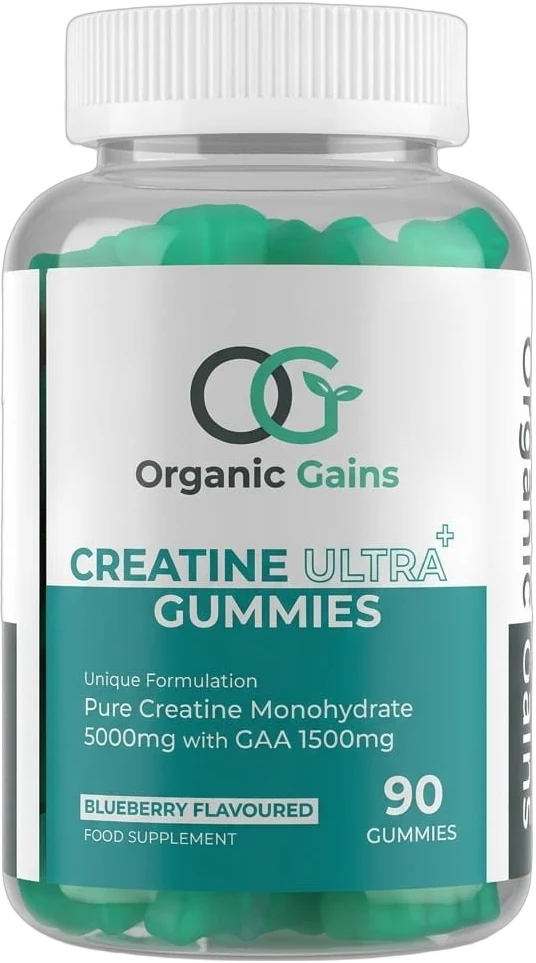
Two of our Creatine Ultra+ Gummies give you 3,333mg of creatine monohydrate and three give you 5,000mg. For adults doing high intensity exercise, creatine increases physical performance in successive bursts of short-term, high intensity exercise, and the beneficial effect is obtained with a daily intake of 3g of creatine. Three gummies cover that 3g: creatine monohydrate is 87.9% creatine by weight, so 5,000mg of it carries about 4,395mg of creatine. There are 90 blueberry gummies in a jar, which lasts 30 days at three a day or 45 days at two.
Each serving also carries GAA (guanidinoacetic acid): 1,000mg in two gummies and 1,500mg in three. The label lists it on its own line, so the amounts above are creatine monohydrate alone. UK law authorises no health claim for GAA.
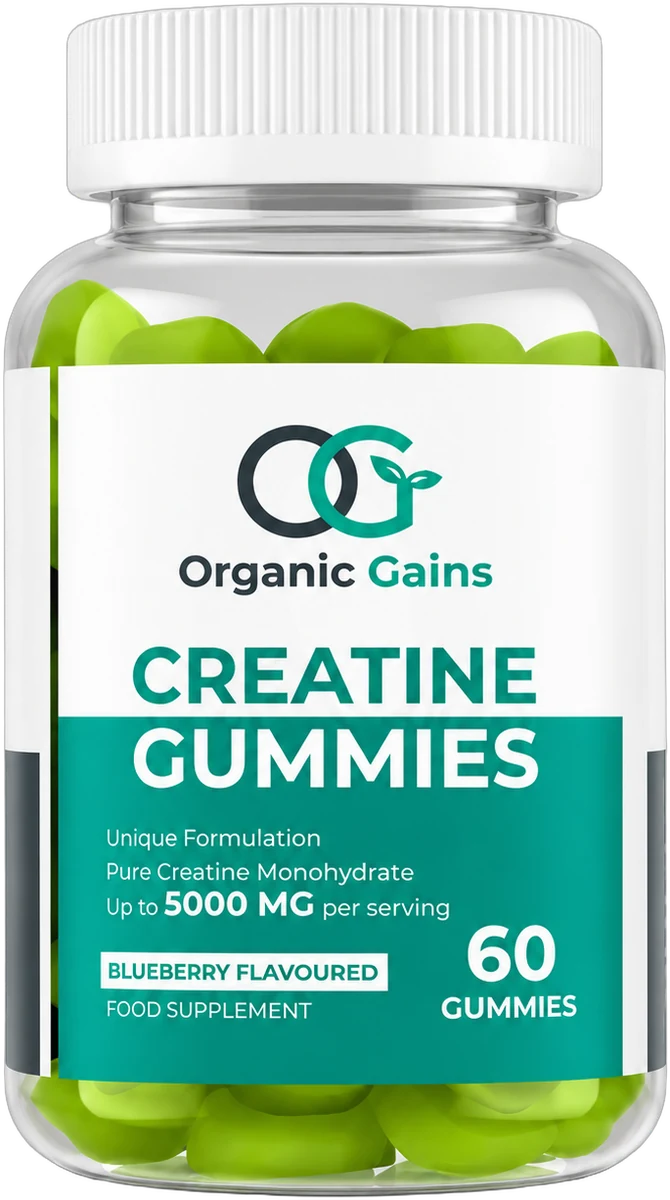
Our Creatine Gummies are pure creatine monohydrate with no GAA: up to 5,000mg of creatine monohydrate in a serving of three, and 60 blueberry gummies in a jar. Both are marked vegan, gluten free and no added sugar, and both come measured, with no scoop to level and no shaker to wash. To match the number of gummies to your routine, see how many creatine gummies to take a day.
If 3 to 5g of creatine monohydrate a day is where you want to be, two or three Creatine Ultra+ Gummies with breakfast or after training will get you there, with free UK delivery on orders of £50 and over.